





























18.Instructions for Settings->Audio menu
Select 3.5mm output mode:
switch the output mode of the multifunctional output port, with options for PO/LO/SPDIF. The default is PO. (When switching to LO, a pop-up prompt will show up saying that Line output is not affected by volume control, and switching to line output will set the output volume to maximum, potentially causing harm to headphones and human hearings! Please unplug the headphones and select the appropriate device for correct connection before switching to line output). When turning on "Adjustable volume for line output," there is no prompt.
Select 4.4mm output mode:
BAL/BAL LO available, with BAL out as the default.
(The input priority between 3.5mm and 4.4mm headphone ports: The output will be given priority in the order of insertion.)
Personalized sound
Flat
Enhanced sound quality
PCM OUT mode
Two options are available, NOS mode (native sampling output) and OS mode (upsampling to 352.8 kHz/384 kHz output). OS mode is enabled by default. This setting only takes effect when using coaxial/analog output in local playback mode.
DSD OUT mode
Two options are available, Native (native DSD signal output) and D2P (DSD signal converted to PCM output). D2P is enabled by default. This setting only takes effect when using coaxial output in local playback mode.
Gain
There are four gain levels: high, medium, low, and super high gain modes, corresponding to four levels of output voltage. You can choose different gains according to your headphones.
Note: The Super high gain mode is hidden by default and available only when inserting a fast charging power supply.
Bluetooth Audio Encoder
The default codec for Bluetooth transmission is the highest supported codec, and you can select the supported codec through this setting.
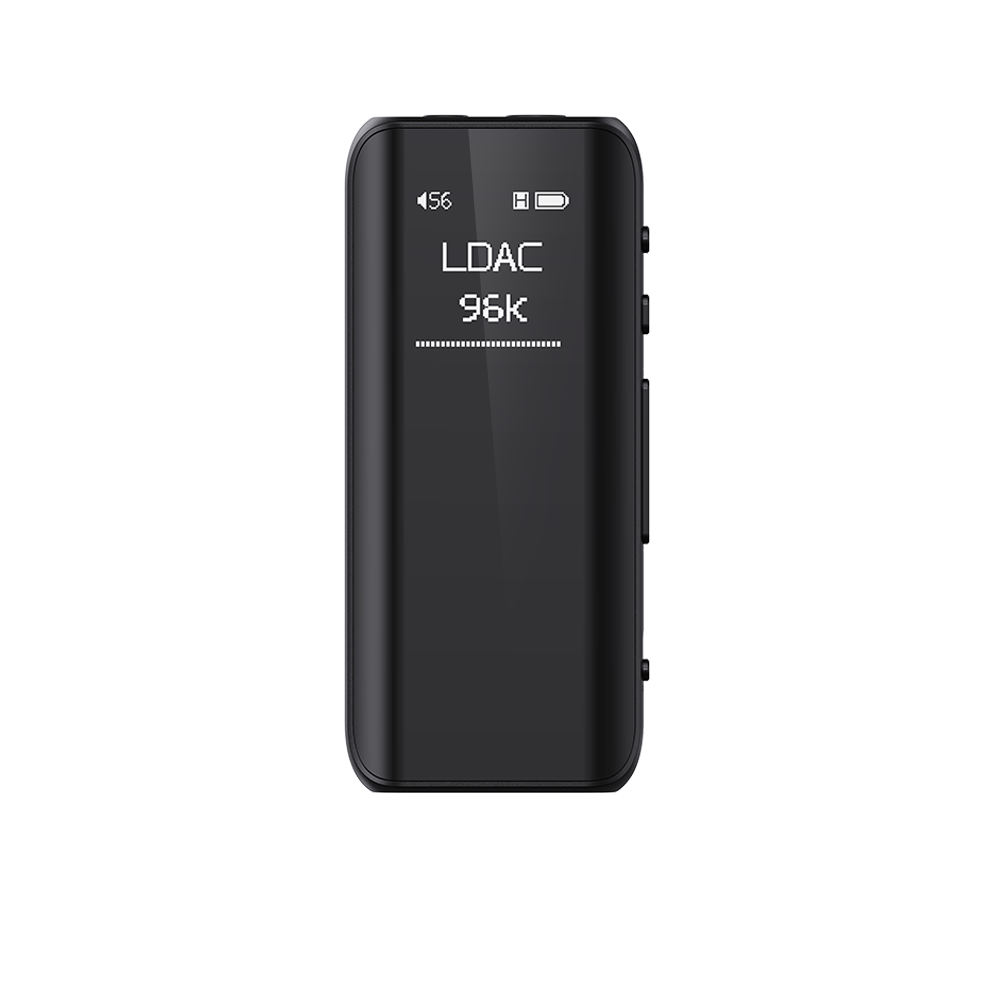
Bluetooth Audio LDAC Encoder: Playback Quality
Allows switching between different playback quality modes for LDAC, including options for prioritizing audio quality (990kbps/909kbps), balancing audio and connection quality (660kbps/606kbps), emphasizing connection quality (330kbps/303kbps), and providing optimal sound quality whenever possible (Adaptive Bitrate). Only available for Bluetooth transmission.
Bluetooth Audio LHDC Encoder: Playback Quality
Allows switching between different playback quality modes for LHDC, including options for prioritizing audio quality (900kbps), balancing audio and connection quality (500kbps/560kbps), emphasizing connection quality (400kbps), prioritizing low latency (256kbps), and providing optimal sound quality whenever possible (Adaptive Bitrate). Only applicable for Bluetooth transmission.
Bluetooth volume adjustment mode
This function is only available for Bluetooth transmission, which features “Sync Bluetooth volume” and “Indep Bluetooth volume”. The Sync Bluetooth volume should also be supported by the receiving device, otherwise, it will be unavailable. The Indep Bluetooth volume means the volume adjustment of the receiver and transmitter is independent of each other. The Sync Bluetooth volume mode can solve the issue of overly small volume when connecting to some Bluetooth headphones, such as AirPods.
Balance
Channel balance means, by adjusting the output amplitude of the left or right channel individually to build up a special listening condition suitable for the users. For users who have no difference in hearing between left and right ears, there is no need to use this function, as the output of the left and right channels of the device is balanced. The default value of channel balance is 0, each of the left and right channels can be adjusted by 20 levels, and each level has a fixed difference of about 0.5dB.
All to DSD
After turning on the All to DSD, the global PCM audio will be converted to DSD for output, and the sound quality will be further improved.
Principle: The most important thing of All To DSD is to convert the digital signal in PCM format to DSD format, so that the DSD format can be used when performing D/A conversion to obtain different styles of sound, more clear and natural sound. In addition, since the lowest DSD format is DSD64, which is 4 times the data of 44.1k/16bit only calculated from the amount of data, All to DSD is also equivalent to up-sampling the PCM signal. The effect of All to DSD also supports third-party apps.
Adjustable volume at LO
When Lineout volume adjustable is enabled, the volume during LO output will be controlled by the buttons (including both single-ended and balanced LO).
System USB output volume adjustable
When this function is enabled, USB Audio output defaults to volume level 45 in non-exclusive mode, and the USB Audio output volume can be adjusted on the player. When disabled, USB Audio output is forced to maximum volume and the volume cannot be adjusted.
Equalizer
The global PEQ function supports EQ superposition of the FIIO Music and other third-party apps. Here are the processes after enabling the PEQ on the system.
(1) Over 192k sampling rate- SRC processing;
(2) Priority: All to DSD>PEQ>MQA.
(3)PEQ is only effective for the analog output under local playback,Android mode,PureMusic mode, and AirPlay. lt is ineffective for Bluetooth receiver mode and USB DAC mode.
Auto pause without headphones
When this function is enabled, under Android and Pure music modes, if the M33 R2R is in music playback state without headphones connected, the system will automatically pause playback after 2 minutes.
